The latest farm profitability figures show a divergence in the fortunes of the arable and livestock sectors. This comes from Defra’s latest Farm Business Income (FBI) figures for England. The data relates to the 2024/25 year – covering harvest 2024 and the 2024 BPS payment. They are an update of the estimates released in the spring. Although titled ‘income’ what the series shows is average profit at the farm level for a typical farm in each sector. The chart below summarises the data for the past few years – all figures are in real terms at 2024/25 prices.
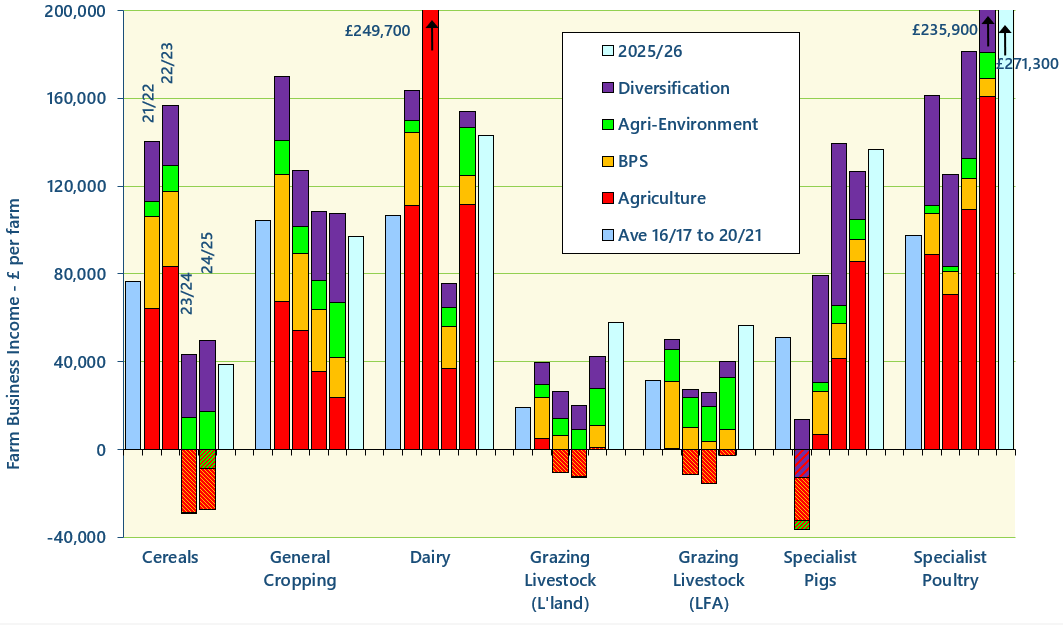
An average is first given for the five years 2016/17 to 2020/21. The data for the four following years has been split into the contribution from each of four ‘profit centres’. It shows how important subsidy income (BPS and agri-environmental income) and diversification income has been to the profitability of some sectors of English farming. The light blue columns are our initial forecasts for the current, 2025/26 year (i.e. 2025 harvest and BPS year).
Cereals farms recorded a small increase in profits for harvest 2024 compared to the previous year, however FBI is significantly down on recent years but also considerably below the average from 2016/17 to 2020/21. Cereals farms actually made a £27,400 loss from their agricultural operations in 2024/25. A 9% fall in input costs, chiefly driven by lower fertiliser costs, was not enough to offset a larger decrease in output from crop enterprises. Looking to 2025/26, with a difficult growing season and poor commodity prices, The Andersons Centre’s estimates (covering 2025 harvest) do not look like being any better and with a further decline in BPS payments to a maximum of £7,200, we are forecasting a drop to below the 2023/24 year level.
In real terms FBI for General Cropping farms declined slightly in 2024/25 compared with the previous year, but remained just above the average from 2016/17 – 2020/21. However, it can be seen by the height of the columns on the chart, receipts from agriculture (red column) have been falling and it is actually income from agri-environment and diversification activities that have risen to keep profits stable. The increase in returns from agri-environment will be SFI income, with farmers trying to re-coup some of lost BPS payments. The orange segment shows the BPS returns and it can be seen how quickly this has fallen. For the current year, we are estimating a decline to below the average for the 2016/17 to 2020/21 years, due to low commodity prices and the knowledge that the BPS has been restricted to a maximum of £7,200 per farm; this compares with an average of £18,100 received in 2024/25.
After a decline in FBI for Dairy farms in 2023/24, incomes recovered in 2024/25. This was driven by an increase in the milk price. The average farmgate milk price rose by 8% in the period. The increase in cattle prices more generally, has also assisted Dairy farms as output from other cattle enterprises rose by 38%.
Lowland and LFA Grazing Livestock farms experienced good increases in FBI for 2024/25. For Lowland Grazing farms, in real terms, this is the highest income since 2009/10. But, even with strong livestock prices, average Lowland Grazing farms only made £900 from their agricultural activities and LFA Grazing livestock farms actually still made a small loss from agriculture. For average Lowland Grazing farms, income from agri-enviroment has more than doubled and diversification receipts have also increased. For the current, 2025/26 year, we are forecasting the strong livestock prices, particularly for beef, and low feed costs will result in a further increase. LFA Grazing Livestock farms rely heavily on their agr-environmental activities which are 57% higher than in 2023/24, equating to 59% of the average FBI for these types of farms in 2024/25.
For specialist Pig farms, although the average FBI in 2024/25 fell from 2023/24 levels, returns from agriculture (red bar) were much improved. A drop in feed costs was a key driver. The main reason for an overall decline from 2023/24 is a drop in diversification income which has fallen by about two thirds with lower output from food processing & retailing, tourism and building rental. However, as was noted last year, there is always a note of caution around both the Specialist Pig and Poultry figures as the samples are relatively small, meaning individual farms can have a large influence on the results, this is possibly what has happened here with the diversified enterprises. For the 2025/26 year, with feed costs still low, a small increase in profits is forecast.
Specialist Poultry farms have had another good year. Income from agriculture, agri-environmental and diversification all experienced strong increases year-on-year, only returns from BPS have fallen. Profits are forecast to increase further for next year. The full Defra report can be found via https://www.gov.uk/government/statistics/farm-business-income.
If you found this article useful, there are numerous additional articles published each month on our Professional Update bulletin service. You can access a no obligation 90-day free trial via the link below.
Sign up to the Professional Update